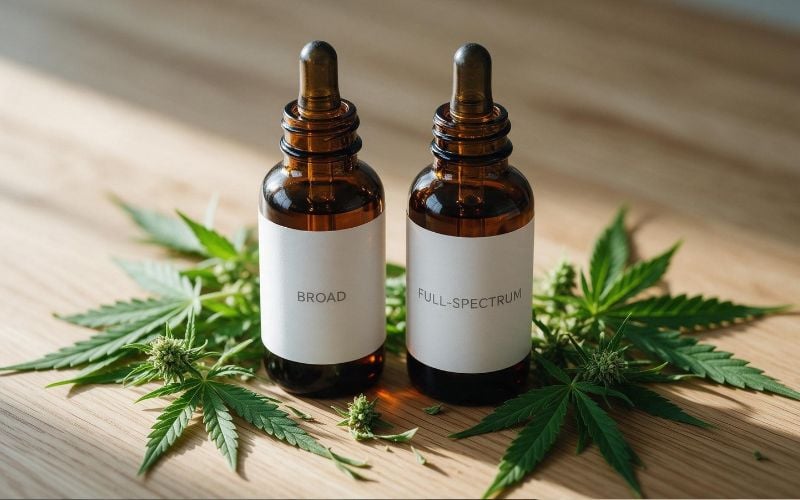
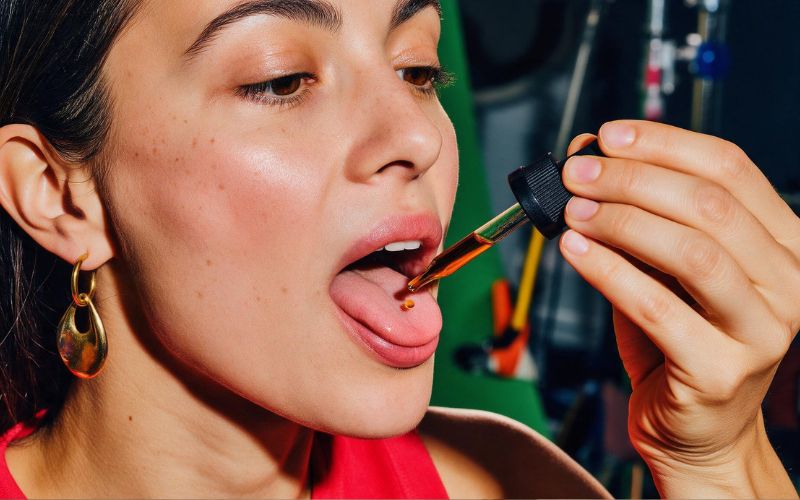
Standing in front of a shelf of CBD oils can feel like reading a menu in a language you only half know. Full spectrum, broad spectrum, isolate. They all sound good, but what do they actually mean for you?
Here’s the short answer. The biggest difference in the full spectrum vs broad spectrum CBD debate comes down to one thing: THC. Full spectrum keeps a trace amount. Broad spectrum removes it. That single detail affects everything from drug tests to how a product may feel to whether it will stay legal after November 2026.
In this guide, you’ll learn how each type is made, the honest pros and cons, what a major federal law change means for full spectrum products, and how to pick one with confidence.
First, a Quick Refresher on CBD
CBD (cannabidiol) is one of more than 100 cannabinoids found in the hemp plant. Unlike THC, its better-known cousin, CBD won’t make you feel high.
Hemp also contains a lot of other interesting compounds. These include minor cannabinoids like CBG and CBN, terpenes (the aromatic oils that give plants their scent), and flavonoids. How much of that plant chemistry ends up in your bottle is exactly what separates the three main types of CBD.
What Is Full Spectrum CBD?
Full spectrum CBD contains everything the hemp plant naturally offers, including a small amount of THC. For years, federal law has allowed hemp products to contain up to 0.3% delta-9 THC by dry weight.
Think of it like orange juice with the pulp. You get the main ingredient plus all the extras that came along for the ride.
Pros of Full Spectrum CBD
- Offers the best shot at the “entourage effect” (more on that below)
- The least processed of the three types
- Often has a richer, earthier flavor and aroma
- Many longtime users say it simply feels more effective
Cons of Full Spectrum CBD
- Trace THC can build up in your body and trigger a positive drug test
- Not ideal if you’re sensitive to THC
- The earthy taste isn’t for everyone
- Its federal legal status is changing in late 2026
What Is Broad Spectrum CBD?
Broad spectrum CBD starts life as a full spectrum extract. Then manufacturers add a refining step, often a process called chromatography, to pull out the THC while keeping most of the other cannabinoids and terpenes.
Pros of Broad Spectrum CBD
- THC is removed, usually down to “non-detectable” levels
- Keeps many of the minor cannabinoids and terpenes
- A great middle ground if you want plant compounds without THC
- Much more likely to meet the new federal THC limits
Cons of Broad Spectrum CBD
- Extra processing can strip out some terpenes too
- “THC-free” isn’t always a guarantee, since tiny traces can remain
- May offer a weaker entourage effect than full spectrum
What About CBD Isolate?
CBD isolate is pure CBD, usually 99% or higher, with everything else removed. It has no taste or smell, which makes it easy to add to food or drinks.
Isolate is the safest bet for avoiding THC completely. The tradeoff is that you lose all the supporting compounds that make full and broad spectrum products unique.
Full Spectrum vs Broad Spectrum CBD at a Glance
- THC content: Full spectrum has trace THC. Broad spectrum is usually non-detectable. Isolate has none.
- Other cannabinoids: Full spectrum keeps them all. Broad spectrum keeps most. Isolate keeps none.
- Terpenes: Full spectrum has the most. Broad spectrum has some. Isolate has none.
- Drug test risk: Highest with full spectrum, low with broad spectrum, lowest with isolate.
- Best for: Full spectrum suits people who want the whole plant. Broad spectrum suits people who want plant benefits without THC. Isolate suits people who want only CBD.
The Entourage Effect: Does It Really Matter?
You’ll hear the term “entourage effect” a lot when comparing these products. It’s the idea that cannabinoids and terpenes work better as a team than any one of them does alone.
The theory got a big boost from a 2011 review by neurologist Dr. Ethan Russo in the British Journal of Pharmacology. Later, a 2015 study from the Hebrew University of Jerusalem found something interesting in mice. Pure CBD’s anti-inflammatory benefit peaked at a certain dose and then dropped off. A whole-plant extract kept working as the dose went up.
Here’s the honest part, though. Most of this evidence comes from lab and animal studies. Human research is still limited, so the entourage effect is promising but not proven. If you want to explore it without THC, broad spectrum still gives you many of the supporting compounds.
Will Full Spectrum or Broad Spectrum CBD Show Up on a Drug Test?
Most drug tests don’t look for CBD. They look for THC and its byproducts.
With full spectrum CBD, the THC amount per serving is tiny. But if you take it daily, especially at higher doses, it can build up over time. That makes a positive result possible.
Broad spectrum carries a much lower risk, but not zero. Labels aren’t always accurate. A 2017 study in JAMA tested 84 CBD products sold online and found that only about 31% were accurately labeled for CBD content. THC turned up in 18 of them.
If you’re tested for work, sports, or legal reasons, your safest choices are isolate or a broad spectrum product with a lab report showing non-detectable THC. It’s also wise to check with your employer or doctor first.
The 2026 Hemp Law Change and What It Means for Full Spectrum CBD
This part is brand new, and it matters a lot. In November 2025, Congress passed a federal funding law (Public Law 119-37) that rewrites the legal definition of hemp. The change is scheduled to take effect on November 12, 2026.
Two updates are especially important for CBD shoppers:
- Hemp will be measured by total THC, which includes THCA, not just delta-9 THC.
- Finished hemp products will be capped at 0.4 milligrams of total THC per container. That’s per whole bottle or jar, not per serving.
A typical full spectrum oil can contain several milligrams of THC per bottle. Industry groups estimate that most full spectrum products on the market will no longer qualify as legal hemp under this rule. The White House has asked Congress to create an exception for non-intoxicating full spectrum CBD, and several proposals are being discussed. As of this writing, though, the cap is still on track.
Broad spectrum and isolate products are far more likely to stay compliant. If you love full spectrum, check the latest news and your state’s rules, since some products may only be available through licensed cannabis dispensaries going forward.
How to Choose the Right CBD Product for You
Once you know the differences, picking a product gets a lot easier. Walk through these steps:
- Decide how you feel about THC. If you’re fine with trace amounts and they’re legal where you live, full spectrum is an option. If not, go broad spectrum or isolate.
- Think about drug testing. If testing is part of your life, skip full spectrum.
- Always read the Certificate of Analysis (COA). A trustworthy brand posts third-party lab results for every batch. Make sure the batch number matches your bottle, and check the THC level, CBD amount, and screens for heavy metals, pesticides, and solvents.
- Check the label math. Look for total CBD per bottle and per serving so you know exactly what you’re taking.
- Start low and go slow. Begin with a small dose and give it a week or two before adjusting.
- Talk to your doctor, especially if you take medication. The FDA notes that CBD can interact with other drugs, including blood thinners like warfarin, because it affects the liver enzymes that process many medications.
Want to compare specific options?
So, Which One Should You Pick?
- Choose full spectrum if you want the whole-plant experience, you don’t get drug tested, and it’s legally available to you.
- Choose broad spectrum if you want terpenes and minor cannabinoids but would rather skip THC.
- Choose isolate if you need zero THC or want a flavorless product for precise dosing.
Frequently Asked Questions
Is full spectrum CBD stronger than broad spectrum?
Not necessarily. Strength depends on how many milligrams of CBD are in the product. Some people feel full spectrum works better because of the entourage effect, but a high-quality broad spectrum product can be just as potent.
Can full spectrum CBD get you high?
At normal doses, it’s very unlikely. The THC level is too low to cause a high for most people.
Is broad spectrum CBD completely THC-free?
It’s usually labeled “non-detectable,” meaning the lab couldn’t measure any THC. Tiny traces may still exist, so always check the COA.
The Bottom Line
Full spectrum vs broad spectrum CBD isn’t about which one is “better.” It’s about which one fits your life. Full spectrum gives you the whole plant, trace THC included. Broad spectrum gives you most of the plant without the THC. With the 2026 law change around the corner, broad spectrum is also the more future-proof choice for many shoppers.